SERVICES
Basic Life Support Ambulance
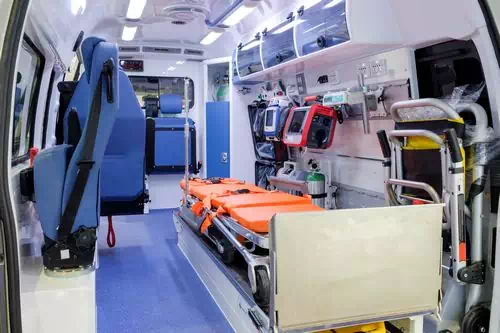
Patients who do not need intensive prehospital care or continuous cardiac monitoring are better served by one of these ambulances. Basic life support ambulances are used to stabilize patients with non-life-threatening injuries or diseases en route to a hospital, where they can get more extensive treatment. EMTs, paramedics, and other medical professionals, as well as skilled bystanders, staff these ambulances. A patient bed, pulse oximeter, and oxygen supplies are all included. Automatically loading stretchers and wheelchairs are also an option. The standard basic life support ambulance has a blood pressure monitor, a stretcher, and an oxygen tank in case of an emergency.
Advance Life Support Ambulance
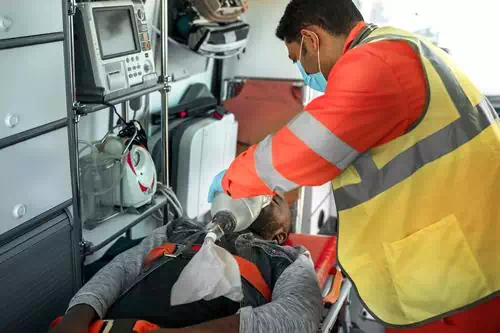
These are also commonly referred to as ” Cardiac Care Ambulance.” They have an oxygen tank, an electrocardiogram machine, a monitor, and a ventilator/defibrillator. Their primary application is in the treatment of cardiac arrest and other disorders requiring the administration of oxygen and respiratory assistance to severely unwell patients. Patients who require advanced medical care en route to the hospital are transported by ALS ambulances. A paramedic or specialist in the patient’s condition is always on hand at these emergency ambulance services. They are outfitted with all the necessary advanced life support equipment, such as a cardiac monitor, incubator, IV supplies, ventilator, defibrillators, oxygen cylinders, nebulizer, resuscitation kit, and BP apparatus, to aid the critically ill or injured patient or cardiac patient.
Patient Transport Ambulance
Patients are transported in these ambulances to and from hospitals. This ambulance, often called a Non-Emergency Patient Transfer or Transport, is for patients who need constant clinical monitoring but are not in immediate danger, such as those who are wheelchair-bound and require assistance getting around. Vans, buses, and other vehicles can easily be transformed into ambulances for such non-emergency transport. A patient bed and other essential life-sustaining equipment can be found there.
Mortuary Ambulance
The primary purpose of these ambulances is to transfer someone who has passed away. In India, all varieties of ambulances have access to the same standard set of life-saving instruments and pharmaceuticals. Transporting a body by mortuary ambulance is less complicated and requires no additional paperwork beyond a death certificate issued by a medical facility. Our ambulance has a freezer box and is the most practical option for large journeys as well. We provide refrigerated vehicles with onboard freezing technology to prevent the decomposition of the body throughout the long journey.
Download Now
FAQ's
Book ambulances in emergency and experience our seamless platform.
Unconsciousness or fainting for no apparent reason; chest pain or pressure indicative of a possible heart attack; abrupt onset numbness or weakness of the face, arm, or leg indicative of a possible stroke; disorientation, problems speaking, understanding, or walking indicative of a possible stroke; emergency situations involving extreme bleeding (even if bleeding has stopped), anaphylaxis, or extreme trauma discomfort are some of the most common scenarios where you require ambulance facilities for an emergency.